One-Hour Run: GT50 Engine Reaches Steady State
Since the engine's first run, our team has completed around twenty further test runs, gently, methodically and carefully expanding the operating envelope one small step at a time. This month brought one of the first big milestones of the test programme: the first time we've run the engine for over an hour in a single session and reached steady state on every single parameter. Here's how we got there.
24 Sep 2026
A Clean Bill of Health After the First Run
The very first job after the GT50's initial run was to inspect the engine and confirm that nothing had been damaged and that everything had behaved exactly as expected.
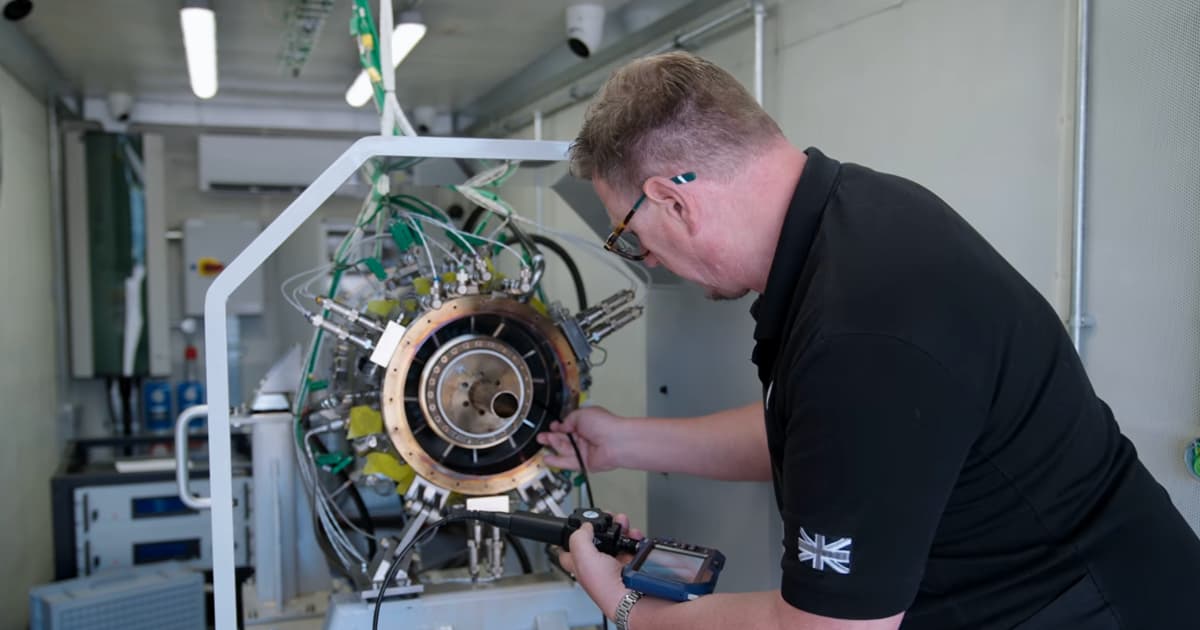
We stripped off the fuel manifold and inspected every fuel nozzle and swirler. Then, using the access we'd created, we went into the core of the engine with a borescope around the combustion liner, across the joint between the liner and the nozzle guide vane, in from the back of the engine to examine the turbine blades from the front, and on to the compressor.
The verdict? No evidence of any rubs, no loss of integrity in any component, and no unexpected behaviour at all. It performed exactly as we hoped it would.
Twenty Runs in a Month
With the engine confirmed healthy, the next phase was to roll out new equipment onto the test rig, finish the functional testing, and then start pushing the engine through faster, hotter and higher-power design points, running for longer periods to very gently, methodically and carefully expand the operating envelope and build experience on the engine.
Around twenty test runs later, a lot of small incremental changes have added up to real progress.
Inside the Upgraded Test Cell
Containment comes first
Before any high-speed work, safety systems lead the way. A blade-off containment structure now slides over the top of the engine during early high-speed tests, designed to safely contain the release of blades while we shut the engine down. For the hotter, higher-speed runs to come, a concrete structure will be built around the outside of the container, capable of containing a disc burst — essentially a total catastrophic event within the engine. For the next few runs, blade-off containment is all we need.
150 sensors, fully calibrated and logging
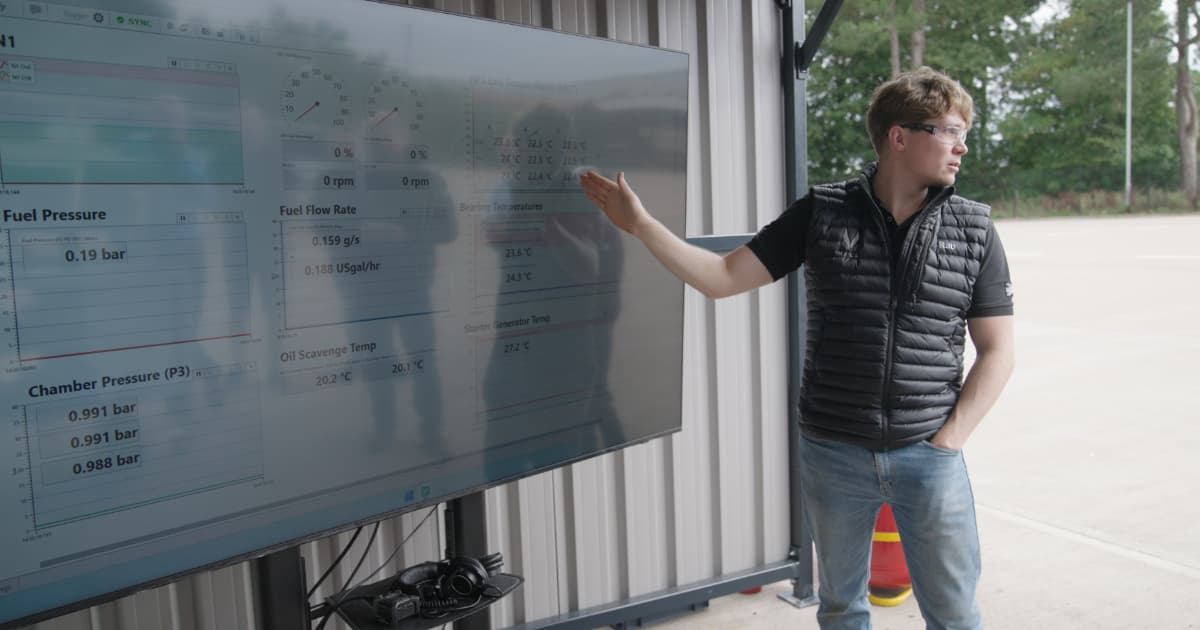
The biggest visual change to the engine itself is that all 150 sensors are now fully connected, calibrated and neatly routed back to the data acquisition systems. That means we can monitor every little detail of the engine live during tests.
Just as importantly, we log everything. Once a test point is complete, we can go offline and compare how every single aspect of the engine is performing against how it was designed and predicted to perform, spotting any nuances that need tweaking, tuning or better set-up before we move on to the faster, hotter, harder tests that really exercise the engine.
Fuel and lubrication systems, moved off-engine
We're continuing to use off-engine support for the fuel and lubrication systems so we can get both tuned perfectly before our own accessories go on the front of the engine. The lubrication rig gives us independent control of every pressure feed, every scavenge feed and the rate at which returning oil is heat-exchanged in the tank, allowing us to tune delivery and scavenge rates and so minimise the size and weight of the accessory pump that will be mounted on the GT50 as standard, simply by tuning the face width of its gear pumps.
Outside the container, we can now refuel the engine live and modify lubrication and scavenge parameters mid-test from external benches. A much larger fuel tank, fed from our reserve tank across the yard, sets us up for the long runs just around the corner — and a new canopy keeps the team sheltered as we test into the cooler months.
Watching every angle
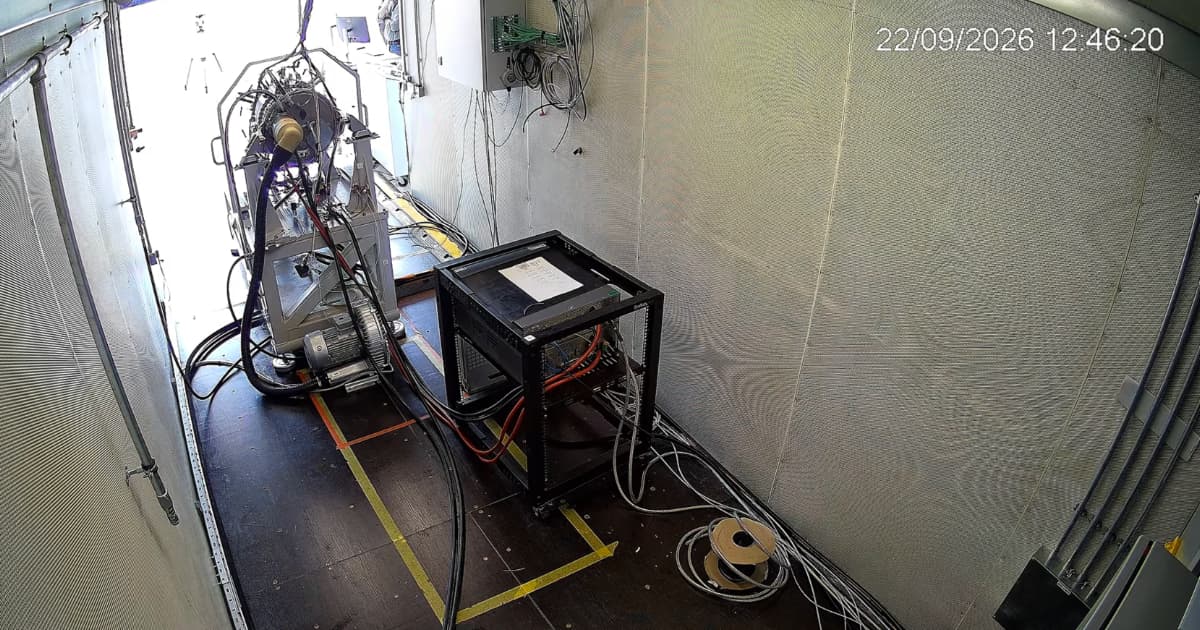
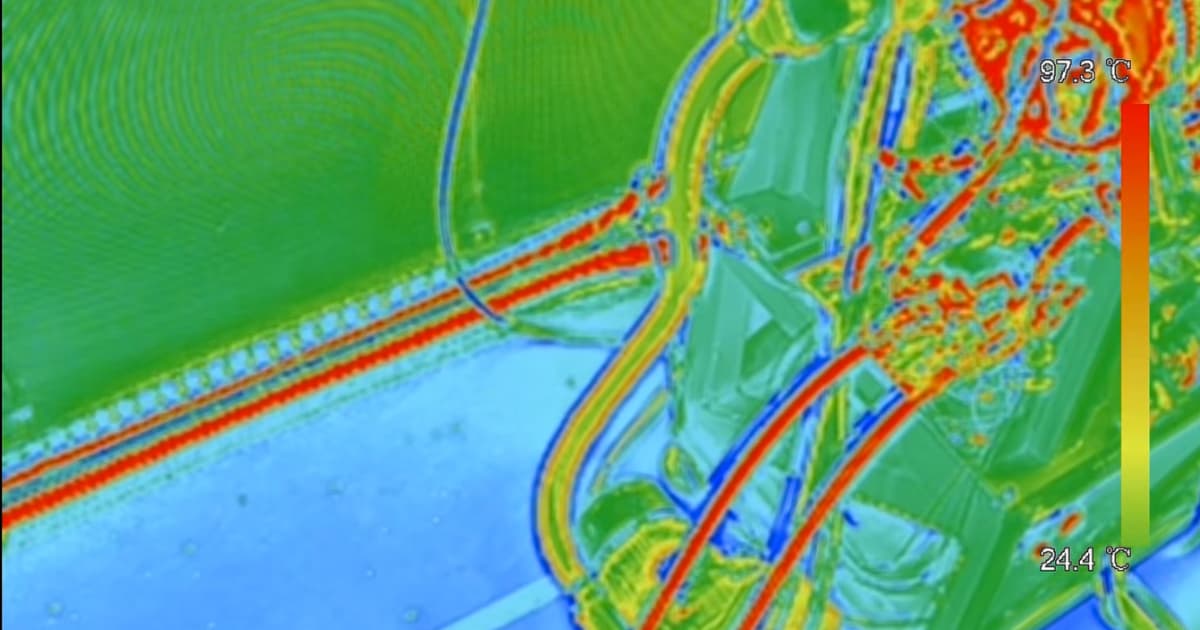
Inside the container, visual cameras in all four corners give us a full video record of the engine from every angle during each test. A thermal imaging camera pointed at the engine lets us calibrate the temperatures of all the surrounding surfaces — and spot any gas leaks from the flanges or anywhere else in the engine the moment they develop.
Getting the Light-Off Right
Ignition performance has been another focus of recent testing. The GT50 has two igniters in the lower quadrants, with multiple locations provisioned and the ability to position them further in or further out of the engine.
To date, ignition performance has been dominated by fuel system dynamics, how we prime and purge the lines and keep the spray nozzles healthy through each test to get a nice, smooth light-off around the whole engine. A lot of time in these early tests has gone into getting that exactly right, keeping temperatures cool during startup and delivering a steady acceleration through the early stages of ignition and run-up.
Balancing the Lubrication System
The other critical area has been the lubrication system: getting each of the flows set up and balanced nicely. As we progressively run for longer and push the engine a little harder, we're making sure it reaches a proper thermal equilibrium, with the flow dynamics set up to extract the heat we need from the bearings and the core of the engine, keep the oil in the tank at a reasonable temperature, and keep both the pressure and scavenge pumps running.
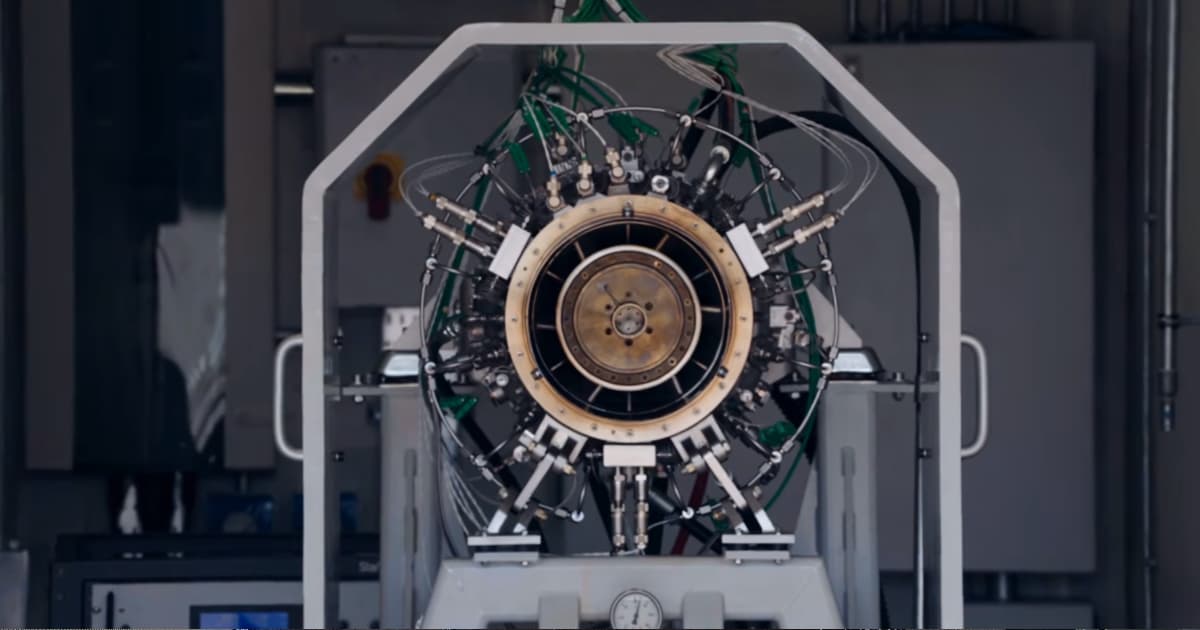
The One-Hour Run
Today was a day of firsts for the programme: running the engine with all of those systems proven out, for much longer.
In the morning, we ran the engine for over an hour to bring it to steady-state operating conditions:
- Stable lubrication temperatures
- Stable scavenge
- Stable bearing temperatures
- Uniform temperatures out of the combustor
Then in the afternoon we went again, a second hour-long run, this time with the conical exhaust fitted to the back of the engine, which sets the pressures throughout the engine properly. The result? Bearing temperatures stable, combustion temperatures stable, oil feeds and pressures stable. The engine sat there running really, really smoothly, and working beautifully.
The path from here is clear. We'll build some more hours on the engine and bank more experience, fine-tune some of the lubrication temperatures, and then it's on to envelope expansion, pushing the GT50 harder, faster and hotter against the full set of pressure boundary conditions.



JOIN OUR GROUP PRESENTATION
Are you interested in the HX50? Book your spot in our group presentation and learn why the HX50 will be better than your current helicopter.
What's in the presentation
Who
Mischa Gelb (aka Pilot Yellow) and Ruben Dias
What
Exclusive full details about the HX50 not yet available to the public
How
30-minute presentation + Q&A
Be part of the journey
Get all the relevant news and updates about the HX50 delivered to your inbox.

HX50
Exterior Concept
Interior Concept
GT50 Turbine Engine
General Aviation 2.0
Hill Digital Cockpit
News & Stories
Technical Details
Range Simulator
Journey to HX50
ADDRESS
Hill Helicopters
Unit 3, Shackleton Way
Stafford, ST16 1GY
United Kingdom
Contact
General Enquiries:
+44 (0) 1384 590700
Accounts:
+44 (0) 1384 590700
Sales:
+44 (0) 1889 228040
hello@hillhelicopters.com
ADDRESS
Hill Helicopters
Unit 3, Shackleton Way
Stafford, ST16 1GY
United Kingdom
© 2026 HILL HELICOPTERS